Speciality Socket Sets
Tom Vondrasek | 2 December 2025 | 4 minutes to read
Specialty socket sets are sets that are not used on a standard hex shaped nut or bolt. Fasteners have evolved and the simple hex headed bolt, while still in the majority, has a lot of competition from a wide range of speciality suppliers. It is not the nuts, more the bolt or screw heads that have changed, Most situations you find them in is where there is no nut. Usually a blind tapped hole or inaccessible captive nut.
Most sets don’t come with the usual ratchet and accessories as the expectation is you already own a socket set and can use these for the specialty sockets. If you don’t, no problem as these pieces are all available separately. If you own a set, make sure you match the drive size. (1/4, 3/8 or 1/2 inch)
Lets do a brief overview and look at some of the most common speciality sets on the market today:
Reasons for Specialty Sockets
There is a number of reasons why speciality fasteners exist. In the early days they helped prevent theft, and newer version still do as not everyone has easy access to the tools. Making products tamper proof so you could not easily pull them apart to access internal workings. Whether that is for safety, security or simply protecting copyright.
They offer a positive fit when loosening or tightening a bolt. This stops the tool easily slipping off the bolt when force is applied, which can cause damage to the bolt. They can take greater torque loads as they spread it more evenly over the bolt head. Being an accurate fit, tools last longer as wear and tear is reduced
A lot of the bolts have smaller heads and the tools used to work on them can be more slimline, allowing a smaller footprint when designing and manufacturing components. The positive engagement leaves less room for error and consistent torque specs when used in manufacturing. They do come at a higher cost which is why they are not commonly used in all environments.
Hex or Allen Key Sets

The humble Allen key has been around for a long time and has now been put into a socket for all the reasons listed earlier. You have the drive peg hole at one end and instead of a 6 or 12 point hole at the other there is a protruding bar. The bar is not round, instead it is a hexagonal shape when viewed from the end.
The bolt head has this size hexagonal hole in the top of it and it is a firm fit. Slightly to big won’t fit and if too small you will feel play or movement. There should be no play if the fit is correct. The thing to be aware of is they come in metric and imperial sizes so you need to know which type you need.
Torx Sets
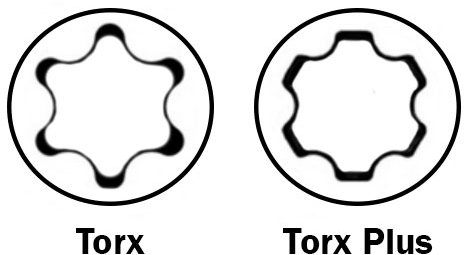
Torx is a trademark brand that has become very popular. Very similar to a hex socket the protruding piece is round. At the top or end it has had 6 equally spaced grooves machined or pressed into it. When you look at the end it is shaped like a 6 pointed star. That’s what a lot of people call it, a star.
The bolt head has a hole in it that matches this star shaped pattern. Much like the Allen key the fit is firm with no play when the correct size torx socket is used. There is a new version called Torx Plus which is a modified version of the 6 pointed star. Old tools can be used on this version but newer IP tools are not compatible with the original Torx
Security Torx
To make Torx bolts or screws tamper proof they put a pin sticking up in the centre of it. This stops putting something in the hole like a small flat blade screwdriver and undoing it. The only change to the Torx socket is a hole drilled in the centre of it to allow for the pin. If your Torx set does not have the hole you cannot undo security Torx bolts or screws.
External Torx
This is a different set altogether as the star pattern is on the outside of the bolt head. The socket looks more normal except there is a 6 pointed star pattern in it to go over the top of the bolt head.
Torx Sizes
Torx sizes are incremental with the larger the number meaning the larger the size of the bolt or screw.
Standard or IP Torx – T1 to T100 is the sizing range. The number roughly corresponds to the width across the flats of the star recess.
Security Torx – This uses the same T1 to T100 sizing range as standard Torx. The numbers can have an R or H ( eg T10R or T10H) at the end to signify it is secure or tamper proof. You can use a security Torx tool in a standard Torx but not the other way around.
External Torx – E4 to E44 is the sizing range. The number roughly corresponds to the width across the star points measured externally.
Note: - a T8 is not the same size as an E8.
Spline Sockets

Very similar to a Torx socket which has 6 points a Spline socket can have 12 to 14 points. When viewed from the end, the gap between points on a Torx is more U shaped where a Spline is V shaped. The multiple points help distribute torque loads better across the fastener when tightening or loosening.
Like hex sets they are available in metric and imperial sizes.
Other Specialty Sockets
The range of specialty sockets and fasteners is growing. The ones I have listed above have been around for a long time. New ones of different shapes and styles are now out there. Just have a look at any screwdriver bit set to see what I mean.
The are many reasons for this, including security and making things tamper proof. Some manufacturers don’t want people pulling their products apart or they may be there to stop theft. Torx fasteners for instance are under a copyright so manufacturers need to pay to use them. Getting their own unique version made may be a cheaper alternative.