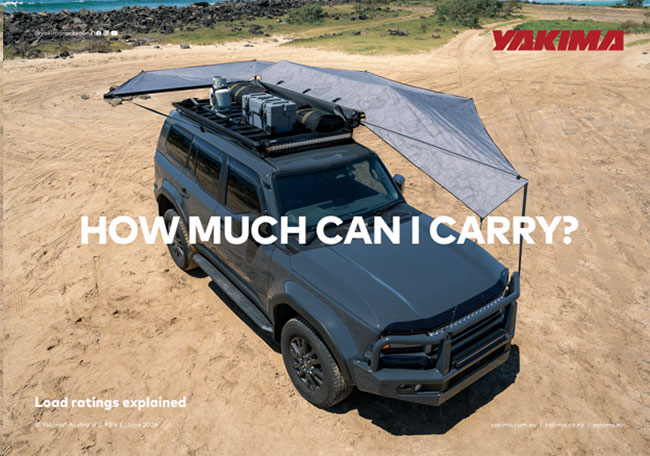
Roof rack load ratings explained
How much can you safely carry?
12th August 2026 | 5 minutes to read
Loading up for a weekend away should be the easy part. But when you are carrying bikes, a roof box, camping gear, a kayak or a rooftop tent, it is important to know how much your vehicle and carrying system can safely handle.
The good news is that roof rack load ratings are straightforward once you know what to look for. The key is to consider the complete carrying system, use the lowest applicable rating and remember that the rack and accessories count toward the total.
Learn how to calculate roof rack capacity, balance your load and carry gear safely:
The Key Points for Load Carrying
Understanding load ratings can feel complicated, particularly when several parts of your roof-rack setup each have their own limits. The key points below summarise how to calculate your available capacity and carry gear safely.
The lowest rating wins: Your vehicle, fitting kit, legs or mounts, crossbars or platform, and carrying accessory may all have different ratings. The lowest number sets the maximum for the complete system.
The rack counts as part of the load: Subtract the weight of your bars, platform, mounts, roof box, rooftop tent and other accessories to find how much capacity is left for your gear.
Dynamic and static ratings are different: Dynamic applies while driving. Static applies only when the vehicle is parked.
Off-road use may reduce capacity: Your on-road rating may need to be reduced as soon as you leave a well-formed sealed road.
A safe load must also be balanced and secured correctly: How you position and tie down your gear matters just as much as how much it weighs.
Proper Load Balancing
When utilising a roof rack, platform, or tub rack, it is imperative to adhere to the specified load rating guidelines. This ensures the safety of vehicle occupants and other road users and helps to prevent damage to the vehicle and its mounting systems.
Recommended Loading Practices
- Ensure all cargo is evenly distributed across the rack or platform to maintain vehicle stability.
- Use approved securing methods, such as high-quality tie-down straps and hood anchors, to fasten loads securely to the vehicle.
- Verify and adhere to the manufacturer’s dynamic (in-motion) and static (stationary) load ratings. Do not exceed these limits under any circumstances.
- Adapt driving behaviour according to conditions:
- In high-wind scenarios or when carrying long or overhanging items, reduce vehicle speed accordingly.
- When driving in off-road or rough terrain environments, lower speeds to match the terrain and minimise stress on the mounting system.
- When loading gear onto Utes, it is important to treat the Cab, Canopy or Tub Racks as seperate loading areas. This means not strapping load across but ratcheting down, this is because on a dual cab ute/truck the canopy and ute tub/bed flex independently of each other and strapping load to both areas can result in damage to gear, roof racks, or the vehicle itself.


Offroad Use
All load ratings are applicable for driving on well-formed sealed roads with a smooth surface. Once you start travelling on any unpaved or poorly maintained roads, the maximum amount of weight you can carry may reduce depending on your roof carrying solution.
Yakima has a diverse range of carrying solutions. Each combination and configuration has specific limits and reductions.
Alternative Mounting Options
Not attaching the roof racks to your vehicle’s roof? Don’t worry, in general the same rules apply if you’re attaching your rack solution to ute tubs/trays, hard lids or canopies.
Check with the manufacturer of your vehicle, tray, hard lid, or canopy to understand their offroad rating reductions and dynamic to static load increases, as this may vary by brand.
Always remember to apply the lowest rating.
Knowing Your Roof Rack
Getting your roof rack load right is mostly about knowing your setup’s limit and remembering that the rack itself adds weight too. Keep everything within the rated capacity, pack it securely, and you’ll be ready to hit the road with confidence.
For the complete breakdown, including worked examples and off-road reductions, download the Yakima Load Ratings Guide.