Reversing Camera Systems
Tom Vondrasek | 20 December 2025 | 5 minutes to read
Modern cars of today have a reverse camera and sensors as a standard fitment. There are still plenty of older vehicles that could use an upgrade to get this feature added to their vehicle. Not only vehicles, caravans, boats and trailers could use this as well. These upgrades can be relatively inexpensive depending on the solution you choose. Don't forget, these assist the driver who is still the most important part of the parking/reversing equation.
A lot are now available with wireless technology which makes the installation a lot easier as a lot of people don't like running cables through the length of their vehicle. This unfortunately happens because the screen is mounted on the dashboard for the driver and the camera is on the rear of the vehicle.
Let's explore some of the options available for you to fit a reversing system to an older vehicle:
Reverse & Forward Parking Sensors
Generally most aftermarket reverse cameras do not come with parking sensors. Parking sensors can be fitted separately and you do not need to have a reverse camera. Sensors systems will do the rear only or some will cover both front and rear
As a standard they come with four sensors that need to be spaced equally apart and mounted in the bumper bar. You can get special mounts to put the sensors under the bar which can be handy if you have a four wheel drive or SUV as the ground clearance is higher. I would not recommend them for a normal car as the sensors would sit too low.
The sensors are connected to a control box by cabling and the control box needs to be connected to power and earth. In the case of reverse sensors this can be done by tapping into the reversing lights of the vehicle. For front sensors this will need a separate accessory power feed.
These control boxes, whether front or rear, wirelessly communicate with the dash mounted unit that will give an audible and sometimes visual warning that something is blocking your direction of travel. The dash mounted unit will also require power and earth to operate.
Parking sensors should never replace the drivers eyes when parking. They are helpful assistant and will warn you of danger even if you don't see it. If not sure why they are alerting, it always pays to stop and check to see what the issue is. If used with a reverse camera they make a great combination.

Oricom 4 x Sensor Reverse System
The Oricom 4 x sensor reverse system is typical of most systems. The 4 x sensors feed into the control box at the rear of the vehicle triggered by the reverse lights. This box connects wirelessly to the speaker in the cabin that beeps or speaks to the driver when a sensor detects an object.
Head Unit Changeover
A head unit change-over can solve a number of issues. For a start it can give you a higher quality audio sound system compared to your old unit. It can allow you to integrate your smartphone if the unit has CarPlay or Android Auto and most head units will allow fitment of a reverse camera. Double DIN units with a screen will allow a reverse camera and some Single DIN units have a screen for a reverse camera.
While this is a more expensive option, you get a lot of extra benefits by going down this path. Reverse camera for head units will need cabling to the rear of the vehicle. Some head units even allowed for the fitting of two reverse cameras so you could use one as a forward facing parking camera.
Head Unit Upgrade
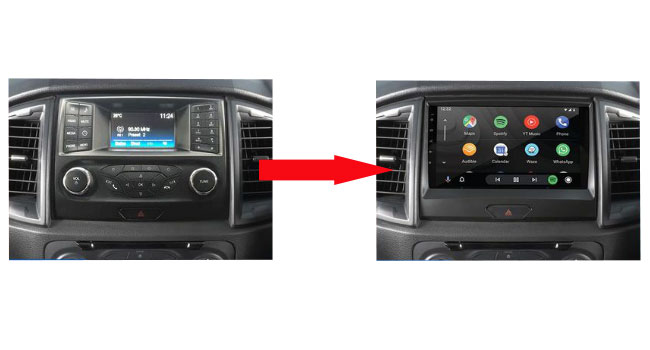
This images shows a before (on left) and after (on right) head unit upgrade on a Ford Ranger by Aerpro. Aerpro and head unit companies like Pioneer now offer head unit upgrade kits for popular vehicles. These kits make upgrades a lot simpler and easier. Aerpro also make a lot of components to upgrade older vehicles as well.
Smart Phone Monitors & Reverse Cameras
Smart phone monitors are a cheap and easy way to get iphone or Android functionality without changing over your head unit. If your vehicle only has space for a single DIN head unit then these are a great alternative. They wirelessly mimmic your smartphones screen onto a touchscreen monitor. What you see on your phone is replicated on the monitor.
You can get audio playback through your existing car stereo via Bluetooth, FM Transmitter or AUX connector. Another feature is that they have a reverse camera. This needs to be cabled from the unit to the rear of the vehicle. A lot of them have reverse triggers to detect the vehicle is in reverse and switch to the reverse camera which then displays on the monitor screen. Much the same way as a head unit.

XView Smartphone Monitor & Reverse Camera
The XView Smartphone Monitor is designed to be placed on the dashboard so the driver can easily see and operate it. It requies power and ground and has a trigger wire for the reverse camera. The reverse camera connects to the unit and need cabling and mounting to the rear of the vehicle.
Rear View Mirror Reverse Camera
There are a few variations of a rear-view mirror reverse camera solution. It is basically a unit that straps to or replaces your existing internal rear-view mirror. It acts as a normal mirror until you go into reverse, then it operates the reverse camera on the back of the vehicle. This then displays on the mirror in a certain area or across the whole mirror.
Some now have dash cams built into them as an extra feature. There is usually cabling involved to power the mirror and to connect to the reverse camera.
Rear View Mirrors with Reverse Cameras
The 2 mirrors on the left have reverse cameras fitted to them. They both act as normal mirrors until the vehicle is in reverse. The upper Parkmate model only uses half the screen for the camera where the lower XView model uses the entire mirror. The Parkmate unit on the right shows the mirror back with reverse camera screen and front with the dash cam lense on the left.

Monitor and Reverse Camera
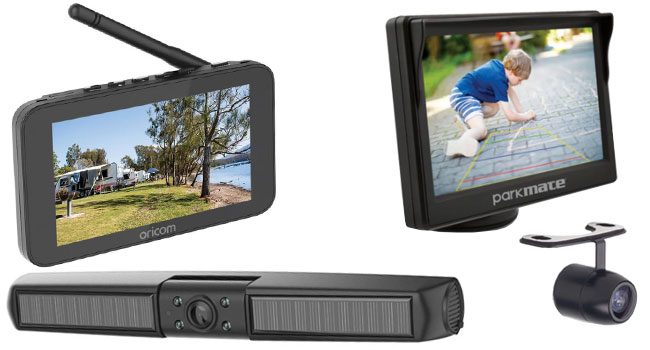
These have been around a long time. It’s a monitor that needs to be mounted on your dash connected to a camera at the back of the vehicle. The monitor needs power and ground to operate and the cameras are either cabled to the monitor or most these days are wireless. The cameras are usually powered and triggered by the reverse light. Some reverse cameras are now solar powered.
Monitors and Reverse Cameras
The unit on the left is an Oricom unit with wireless connectivity to the solar powered reverse camera. The Parkmate unit on the right is a monitor with a reverse camera connected by cabling. Both these units need a place on the dash to put the monitor so could work well in older four wheel drives, delivery vans or light trucks.
Reverse Cameras for Trailers, Boats & Caravans
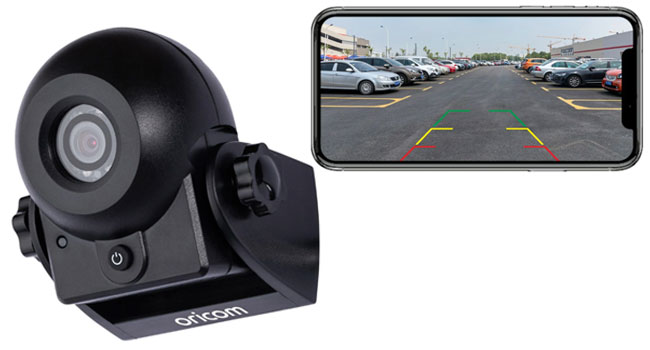
Oricom have a wireless reversing camera with a magnetic base. It connects to your smartphone using Wifi and has a range of up to 15m. Besides the magnetic base there is also a Velcro strip you can use if where you are mounting it is non-magnetic.
It is not designed as a permanent solution though it is very handy when reversing. As most trailers, caravans or boat trailers are metal, finding a place to mount it should not be too difficult. You don’t even need to mount it to the trailer. It can go on a post or wall and give you an overall view of where you are reversing. The only limitation will be its range.
It is powered by a rechargable battery (USB cable), has infrared night vision (Black & white), colour day vision and waterproof rated to IP6X so can be used in the rain. The smartphone app to run it is free. It is really handy if you have multiple trailers as you can go from one to the other. The biggest thing to remember is to remove it when not using it.
You can use it with an older car if you don’t want to add a permanent reverse camera. It will make parking in a tight garage so much easier. It is very easy to use and store. Just recharge it and leave it in the glovebox.
Oricoms Portable Wireless Reverse Camera for Trailers
The image on the left is Oricoms portable wireless reverse camera. The base is magnetic and whether you mount it horizonatally or vertically the unit can be tilted to give the best view. Image on the right is displaying the camera view on a smartphone by using the app.
Reversing Solutions
As you can see there are many solution to the problem of a lack of reverse camera. A lot will come down to personal preference, ease of installation and most importantly cost. If you are worried about doing the installation yourself, contact your local Repco store who can recommend a local installer/workshop that can do it for you.