Deep cycle battery comparison
17th Apr 2025 | 8 minutes to read
We're tackling the common question of which is better to suit you: AGM or Lithium Deep Cycle Batteries. We explore the differences between the two types of 12V batteries and the justified costs of choosing Lithium.
Not only do we find out the pros and cons of these batteries, but we also look into the different applications and styles of 12V setups for our 4WDs.
We’ve compiled a bunch of info on the best dual battery setups for 4WDs:
AGM Batteries
AGM-style Deep Cycle Batteries are still widely used for good reason. They are proven to work reliably, are well-priced, and come in a range of different shapes and sizes to suit your application. They are also sealed, so you can mount them safely inside a vehicle, as well as on their side.
AGM Battery Weight
One of the main issues with an AGM battery when compared to Lithium is the product's weight. In the test we performed during this comparison, the 105Ah AGM battery weighs 28.4kg. That is a significant amount of weight to carry in the back of your 4WD. These batteries are filled with heavy lead plates and electrolyte-filled fiberglass, combining to make a very heavy battery.
Usability and Life
Second is the amount of usable amp hours inside the battery. With the same 105Ah AGM battery used in the last example, you probably only get 50Ah-60Ah of usable battery before you over-discharge it and potentially damage the internals of the battery.
If you have ever wondered why your fridge will turn off when your battery is low, it is because it can damage the battery from draining an overdrawn battery.
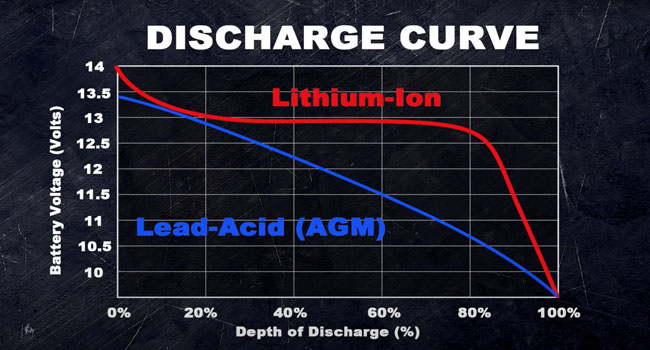
A fully charged, regular deep-cycle battery produces about 12.8-13.0 volts, and once it reads around 12.0V, your battery is about 50% discharged. This means the battery will need charging as soon as possible before risking damage. Once the battery is reading 10.0-10.5 volts, the battery is dead flat, and though it can be charged up, it will never be as good as it was when new.
A dead and damaged battery is the last thing you want when you are in the middle of nowhere and pulling up to camp with your fridge shut off, full of now warm, spoiled food.

Discharging an AGM Battery
The reason why it is not good practice to discharge your AGM battery more than 50% is because, essentially, you are shortening the lifespan of your 12-volt setup. The more times you discharge your battery and the deeper the discharge, the more significantly you reduce the lifespan of your AGM battery.
An analogy for the battery's lifespan is exercise. You can do a lot more low-effort reps, but as soon as you push yourself to do more, you become more tired more quickly. The same goes for your AGM.

Shauno himself has used AGM batteries in the past and, from his experience, gets about 3 years of battery life, assuming he looks after it and never fully discharges the battery.
The best way to preserve an AGM battery is to only use a small bit of charge before you reapply that charge and keep it topped up.
Scientifically, the deeper you discharge your AGM battery, the more sulphates form, which prevents the chemical process a battery needs to do a full recharge. The more sulphates on the lead plates, the more voltage is required to remove them. Failing to recharge the battery immediately will harden and crystallize the sulphates, permanently damaging the internals and reducing the efficiency and capacity of the AGM battery.
Tips for Longer Life for Your AGM Battery
- Hard-mount a solar panel to the roof of your 4WD so it can constantly be topping up the battery, resulting in the battery rarely discharging to damagingly low levels.
- Have a good quality DC-DC charger for your vehicle. These chargers know exactly how much voltage and amps are required to charge your AGM and stop sulphate buildup.
- Fit a voltage meter. This is so you can properly monitor the discharge of your battery. Start thinking about how you will charge the battery when it gets to roughly 12.2 volts to ensure the power never drops into the 11V range.
Shed Test
We tested the same aforementioned 105Ah AGM battery against a 100Ah Lithium battery, connecting each to a 69L fridge. Both were set to exactly 0 degrees Celsius, containing 10L of water in each, and tested to see just how long they lasted.
The fridge running the AGM showed an error after 2.5 days with a voltage reading of 11.15V. This means the battery was over-discharged to a point of reducing the life of the battery.
The Lithium battery, at this same 2.5-day mark, was showing a voltage of 12.9V due to its higher voltage capacity and continued to run for 3 more days.
This test was held in ideal, moderate temperatures in Shauno’s insulated shed, with neither of the fridges being opened during the test. If this was held in higher temperatures and the fridges were opened often, like they would be at camp, expect these results of the battery performances to be less for both AGM and Lithium.
Lithium Batteries
When it comes to Lithium batteries, there are pros and cons as well. The pros of the Lithium battery are actually the negatives of the AGM style: weight and depth of discharge.
Lithium Is Lightweight
The equivalent 100Ah AGM battery weighed 28.5kg, whereas a Lithium 100Ah only weighs 12.5kg. The benefits of a light Lithium battery mean you can mount them in obscure places. For example, Shauno has mounted his two Lithium batteries up the top of his canopy in a rarely used small space. That place would never be achievable when storing 60kg worth of AGM batteries, also reducing the payload of your 4WD.
Lithium is filled with an electrolyte substance that is lighter than fiberglass, rather than heavy lead plates that are used in AGM batteries.
Efficiency and Lifespan
Lithium batteries use their power much more efficiently, meaning the battery will last longer, and you will get a lot more cycles and more discharge from the battery.
For example, discharging your Lithium battery to 50% will give you a lifespan of around 5,000 cycles, and down to 20% will see a battery life of about 2,000 cycles. AGM battery lifespans will give you approximately 900 and 300 life cycles at those respective battery percentages.

Discharge abilities
Another advantage of Lithium Batteries is you can discharge a Lithium to almost completely flat and still get a higher voltage out of that battery compared to an AGM. Essentially you can use about 100% of the useable amp hours of a Lithium battery.
Lithium has the ability to run higher drawing appliances. For example, an angle grinder may draw 40ah when you start it. The tested AGM battery can only handle 30ah max output even though it is a 105ah battery. Now the Lithium 100ah battery has the capability of 100ah of output, easily running that appliance and things such as coffee machines and induction cookers.
The main reason Lithium batteries can perform so well is because of their internals. The two main factors here are the Battery Management System (BMS) and because of the efficient design of the internal cells.
Not All Lithium Batteries Are Created Equal
Keep in mind that cheaper lithium batteries won’t have a max output of 100ah and may not be able to run power thirsty appliances.
Before you choose your Lithium, make sure you identify the batteries C-Class rating and understand how much output the Lithium you choose has. The higher the C rating, the more discharge and max charge capabilities you have.

Voltage
As the amount of voltage drops on your battery, so does the amount of current to a point whereby the voltage will get so low that your accessories will start to turn off. This is because your battery can no longer provide enough current.
A Lithium battery will actually have a higher voltage throughout the whole discharge cycle. If you put that into a practical sense, a lithium battery will keep your inverters and appliances running at camp a lot longer and more efficiently.
Cost of Lithium
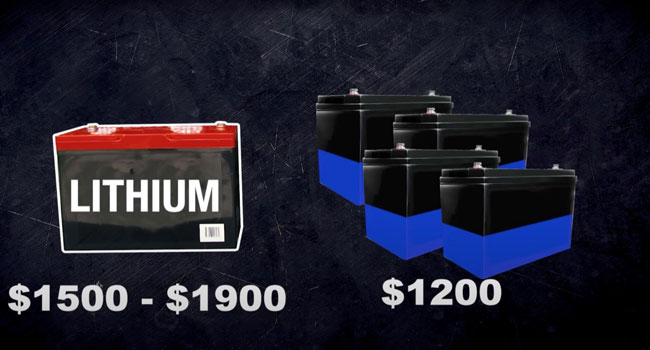
The typical AGM battery will cost you about $300 compared to Lithium models costing anywhere between $1,000 - $2,000.
While you will have a higher initial cost, the life and usage you will get out of a Lithium battery is much more cost effective. To get the same life of one 100ah Lithium battery (10-year life) you would need two 100ah AGM batteries to equal the usable amp hour capacity and replace them at least every 5 years. This means approx. $1,200 on four AGM batteries rather than one Lithium battery.
Running the Right Charger
Lithium batteries have a different charge profile than AGM batteries do. This means you can’t just put any old charger on your Lithium Battery, the charger will need to be Lithium compatible.
When charging an AGM battery, you can only charge at a max input of 25A. Say for example your Lithium battery has a max input of 50ah — like most do — you can charge at twice the speed of an AGM. If your 100ah Lithium battery was flat, you can fully charge it in just 2 hours, rather than 4 hours.
All Lithium batteries have a Battery Management System (BMS) that will protect your battery from excessive discharge and over voltage. This will shut down the battery if there is an issue in order to protect the internals and is simple to restart if it does happen.
Different Battery Setup Types
There are various battery setup types to suit different needs and applications, ranging from flexible and transportable options to more fixed, long-term solutions. Understanding the differences between portable and permanent setups can help you choose the right system for your needs.
Portable
Portable pre-made battery boxes can be easily removed from vehicle to vehicle, into your caravan and even in your boat. They have all your 12v cig sockets, USB ports, Anderson plugs and often come with built-in chargers. Everything ready to go, just lift and carry into your 4WD.
Permanent
In Sooty, Shauno’s iconic 80 series, he upgraded from two permanent AGM batteries to just one Lithium battery.
This was for a few reasons:
- It acts as a set and forget install for the next 10 years
- It saved 50kg
- It opened up extra space for storage

Overview
If you don’t go out camping and 4WDing all that often — say, just a few weekends here and there — then an AGM can definitely suit your needs, and may end up being the more const-effective option, as you might not make up the initial cost of the Lithium battery over time.
But if you are going to use your vehicle to explore remote parts of Australia, have a big fridge, all the lights you want, maybe even an induction cooker or a coffee machine running on big inverters, you will find out that Lithium is what you need.





